
We used the BCD framework, developed by Robert Aunger and Valerie Curtis from London School of Hygiene and Tropical Medicine. BCD is built on the latest insights from evolutionary and environmental psychology, marketing and neuroscience. It has been applied successfully to behaviours ranging from hand washing, to oral rehydration, food hygiene, child and maternal nutrition, and post-operative exercise.
Behaviour determinants
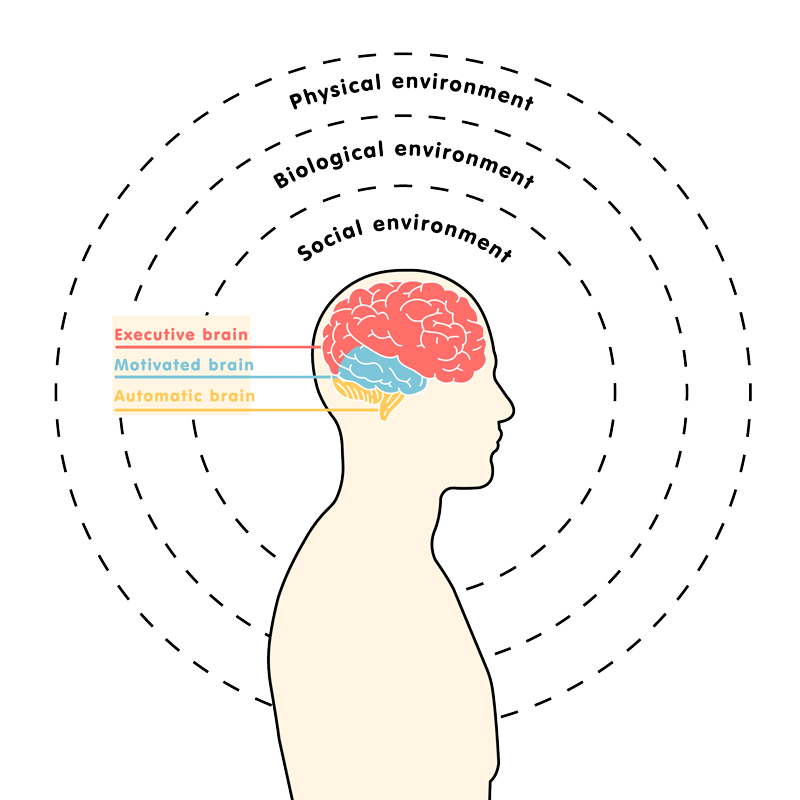
BCD defines behaviour as a functional interaction between a body and its environment, designed to help an organism to get what it needs to survive and reproduce. At the individual level, the framework proposes roughly three regions in the human brain, related to three different types of behaviour:
Automatic brain
produces unconscious behaviours. These include reflexive behaviours such as flinching in response to contact with a flame and habitual behaviours such as driving a car.
Motivated brain
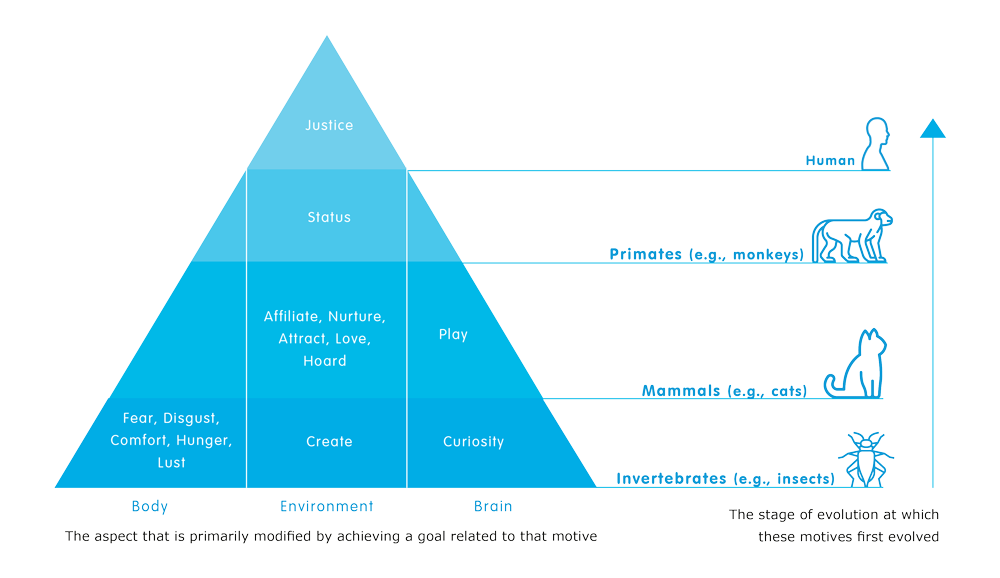
produces sub-conscious behaviours to achieve goals. One of the unique features of the BCD framework is that it has identified 15 fundamental.
Executive brain
produces conscious behaviours. It chooses the behaviour to perform and also plans for the same. While most of the health messaging is targeted at this brain.
Environment
It proposes three levels to the environment that an individual interacts with during the performance of the behaviour.
The motives pyramid
The BCD process
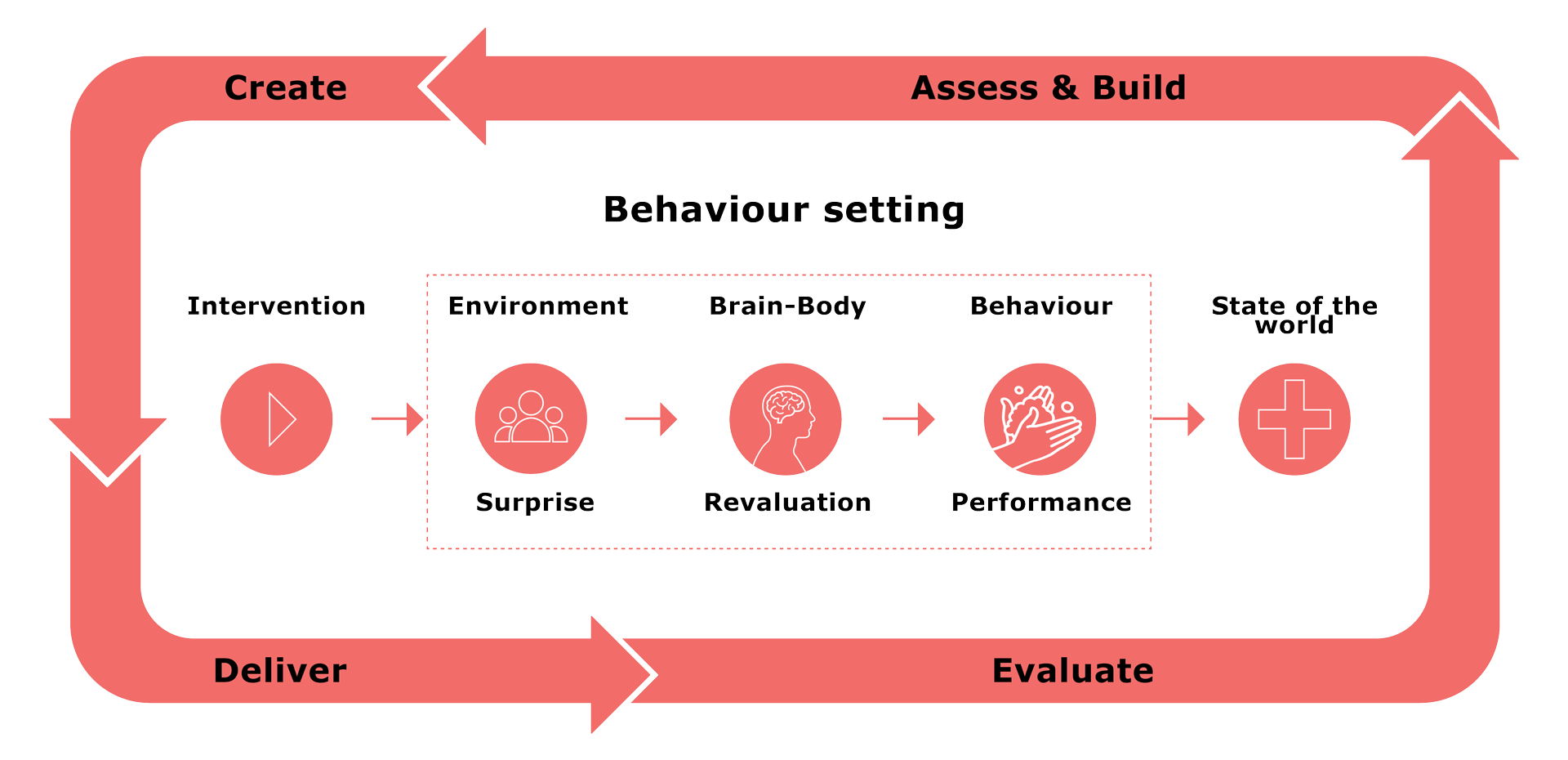
BCD provides a process for designing behaviour change interventions - ABCDE. Each letter explains one of the key steps in the process as seen below.
A-Assess
Universal drivers of behaviour change, informed by local context, can help design effective interventions that are easily scalable.
B-Build
When teams move in lock-step and work on same behaviours, there are efficiencies of design at scale as it avoids duplication of efforts.
C-Create
Learning by doing takes the best of behaviour change theory and makes it practical and relevant, as it is applied to each specific context.
D-Deliver
Strong online facilitation throughout significantly reduces the need for international travel and therefore carbon footprint.
E-Evaluate
Strong online facilitation throughout significantly reduces the need for international travel and therefore carbon footprint.
Theory of change
During the Assess and Build phase of the project, we understand the causal links from the state of the world to behaviour to brain-body to environment. Based on this understanding, the intervention is created, delivered and evaluated.
BCD Resources
Link:
The BCD resources page on the LSHTM website has many free resources that dive deeper into the the BCD framework, including the following:
Behaviour Centred Design, towards an applied science of behaviour change Aunger and Curtis, Behaviour Centred Design - towards an applied science of behaviour change, Health psychology review, 2016
The BCD manual
BCD - Formative research protocols
Books:
Gaining Control - Robert Aunger and Valerie Curtis
Don’t look, Don’t touch - Valerie Curtis
Reset - Robert Aunger